
What Causes VFD Overcurrent Faults?
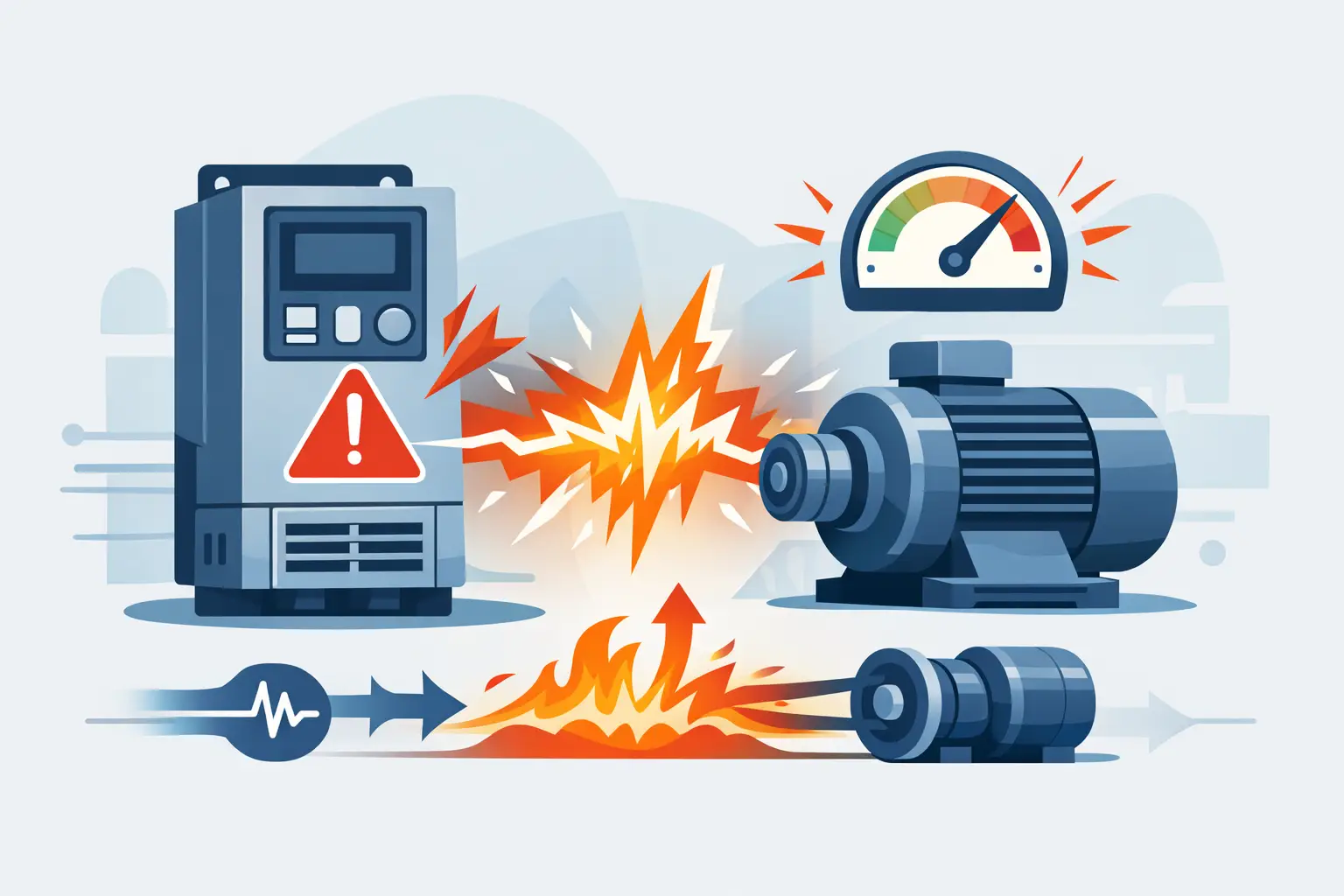
A VFD that trips on overcurrent during startup or while the motor is already running usually points to a real electrical or mechanical problem, not a nuisance alarm. If you are trying to determine what causes VFD overcurrent faults, the fastest path is to separate the issue into four areas: the drive, the motor, the wiring, and the driven load. That keeps troubleshooting practical and avoids replacing the wrong part.
What causes VFD overcurrent faults in real applications
An overcurrent fault occurs when the drive detects output current above its safe threshold. The exact trip point and logic vary by manufacturer, but the common pattern is the same: the drive sees current rise faster or higher than it should during acceleration, deceleration, steady-state operation, or a transient event.
In the field, the root cause is often not the VFD alone. A seized gearbox, shorted motor winding, damaged output cable, incorrect motor data, aggressive accel time, or undersized drive can all produce the same fault code. That is why fault history matters. A trip that happens only at start is a different problem from a trip that appears after 20 minutes at full load.
Startup overcurrent vs. running overcurrent
If the fault happens the moment the drive commands output, look first at short circuits, ground faults, locked rotor conditions, and acceleration settings. If the motor turns briefly and then trips, the issue may be load-related or parameter-related.
If the drive runs for a while and faults later, focus on overload, intermittent wiring breakdown, mechanical binding, bearing drag, unstable incoming power, or an internal drive section beginning to fail. The timing changes the diagnostic path.
Common mechanical causes
A VFD can only control torque within the limits of the motor and drive. If the machine needs more torque than expected, current rises quickly.
The simplest example is a jammed load. Conveyor rollers can seize, pumps can bind, fans can accumulate debris, and gearboxes can develop internal drag. In these cases, the VFD may appear to be the failed component because it trips first, but the drive is often protecting the system from a stalled or overloaded machine.
High inertia applications can also trigger overcurrent if acceleration time is too short. A large fan, centrifuge, or loaded conveyor may be healthy mechanically, but if the ramp is set too aggressively, the drive demands too much current to bring the load up to speed. Extending acceleration time often reduces the current peak.
Deceleration can create a related issue. If the motor is forced to slow too quickly, regenerated energy can stress the system. That more often shows up as an overvoltage condition, but in some setups with unstable control or load transitions, current spikes may also appear during stopping.
Motor-related causes
Motor condition is one of the most common answers to what causes VFD overcurrent faults. A motor with winding insulation damage, partial phase-to-phase shorting, or a developing ground fault can draw excessive current even if it still turns.
A motor that is incorrectly matched to the application can do the same. If the motor horsepower, full-load amps, base frequency, or voltage rating does not align with the drive setup, the VFD may calculate torque and current demand incorrectly. This is especially common after a replacement where the new motor is close, but not identical, to the original nameplate.
Bearing failure can also increase current draw. Electrical technicians sometimes focus only on winding tests, but a motor with rough or failing bearings can impose enough drag to raise current under load. The motor may pass a basic insulation test and still be the cause of the trip.
Long motor lead lengths can complicate diagnosis. Reflected wave effects, insulation stress, and cable-related leakage become more significant as distance increases, particularly on older motors not designed for inverter duty. In those cases, the motor and cable system need to be evaluated together.
Wiring and installation causes
Output wiring problems regularly create overcurrent faults. Damaged insulation, moisture intrusion in junction boxes, loose terminations, and phase-to-phase shorts can all force the drive into immediate protection.
A common field mistake is checking line-side wiring carefully while overlooking the load side. The input to the VFD may be clean, but a crushed motor lead in conduit or contamination in the peckerhead can still trip the drive as soon as output is enabled.
Grounding and shielding issues matter too, although they do not always present as a direct overcurrent trip. Electrical noise, poor bonding, and improper cable routing can create unstable drive behavior, especially in cabinets with multiple high-speed switching devices. This is more likely to show up in complex panel environments than in a simple single-drive installation.
If a contactor or disconnect is installed between the VFD output and motor, its operation should be reviewed. Opening or closing devices on the output side while the drive is switching can create damaging transients. Some systems were built that way years ago, but that does not make it a good operating practice.
Parameter and setup problems
Not every overcurrent fault means bad hardware. Incorrect programming causes a significant share of VFD trips, especially after commissioning changes, motor replacement, or drive swap-outs.
Motor nameplate data should be the first check. If full-load current, rated voltage, rated frequency, speed, or motor control mode is wrong, the drive may apply the wrong current limits or control strategy. Sensorless vector settings on one motor may not behave well on another without a fresh motor identification routine.
Acceleration time is another common issue. Short ramps are attractive because they make a machine feel responsive, but they also increase current demand. The same is true for sudden speed references or torque boosts set too high.
Current limit settings, overload parameters, carrier frequency, and skip frequencies can also affect behavior. There is no universal safe value for these settings. It depends on the motor design, cable length, ambient conditions, and the mechanical load profile. That is why copying parameters from a different machine can create new faults even when both systems look similar on paper.
Drive sizing and drive condition
An undersized VFD is an obvious cause, but not always an obvious diagnosis. A drive may run a lightly loaded machine for months and only begin tripping after process changes, seasonal temperature shifts, or normal wear increases the required torque.
Duty cycle matters too. A drive sized only for steady-state current may still be too small for repeated starts, high breakaway torque, or cyclical shock loads. Nameplate horsepower matching is not enough by itself.
Internal drive problems are less common than load or motor issues, but they do happen. Failed IGBTs, weakened DC bus components, deteriorated current sensors, cooling failure, and contamination inside the unit can all contribute to overcurrent trips. Burn marks, fan failure, capacitor bulging, or repeated faults across multiple known-good motors are signs to look more closely at the drive itself.
If the drive has logged different fault types over time, such as overcurrent combined with undervoltage, overtemperature, or ground fault indications, the pattern may point to a broader hardware problem rather than a single external cause.
How to isolate the fault without wasting time
Start with the fault history and operating condition. Note whether the trip occurs at startup, during acceleration, at constant speed, during deceleration, or only under process load. That narrows the likely causes faster than jumping straight to component replacement.
Then inspect the mechanical load. If the machine can be uncoupled safely, check whether the motor runs without the load attached. A drive that trips only when coupled usually points to torque demand or mechanical resistance. A drive that trips with the motor uncoupled shifts attention back to motor, cable, parameters, or the drive.
Verify motor nameplate entries in the VFD and review acceleration settings. In many service calls, correcting the motor amps value or extending accel time is enough to stop nuisance overcurrent trips.
Next, test the motor and output wiring. Insulation resistance, phase balance, and cable condition all matter. If the installation includes long leads, reactors or filters may need to be considered depending on the drive and motor combination.
If the motor and wiring check out, compare actual load current to drive rating and application profile. A unit that is technically the right voltage and horsepower may still be wrong for the real torque requirement. When replacement is necessary, exact specification matching matters, especially across brands and legacy part numbers.
When replacement makes sense
If troubleshooting confirms failed output devices, repeated faults on known-good loads, or a sizing mismatch that cannot be corrected through setup, replacement is usually the practical move. The same applies when a motor has insulation breakdown or when cable damage is extensive enough that repair is not dependable.
For maintenance and procurement teams, the real goal is not just clearing the fault. It is restoring predictable operation with the right part, the right ratings, and minimal delay. That is where having access to major automation brands and exact replacement components becomes operationally useful.
A VFD overcurrent fault is rarely random. The drive is responding to a condition it sees as unsafe, and that response is useful information. Treat the fault as a signal to verify load, motor, wiring, setup, and sizing in a disciplined order. That usually gets you to the real cause faster than replacing the drive first and hoping the code disappears.