
Top Machine Safety Switches for Industrial Use
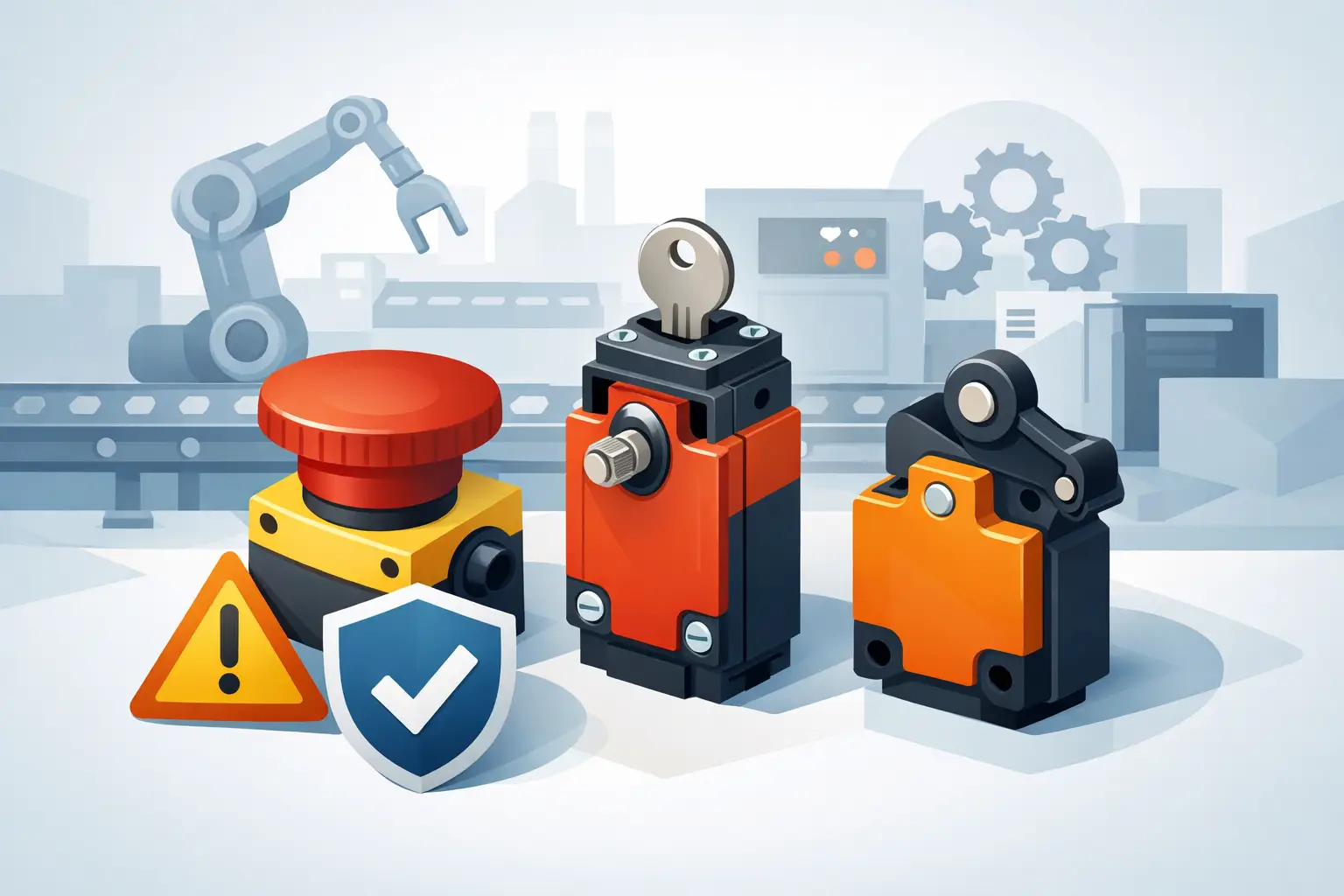
A failed guard interlock can stop a production cell just as quickly as a failed drive or PLC input. The difference is that top machine safety switches must do more than restore operation - they must help the machine reach and maintain a safe state when personnel access a hazard.
For maintenance teams, engineers, and buyers, selection usually starts with an exact replacement part number. That is often the right approach, particularly when preserving an approved machine design. For new builds, retrofits, or discontinued parts, the better question is which switching method fits the guard type, risk assessment, control architecture, and operating environment.
What Makes a Machine Safety Switch the Right Choice?
A machine safety switch is not interchangeable with a standard limit switch. Safety-rated devices use defined contact behavior, fault detection methods, and installation requirements that support a machine safety function. The switch must also work with the safety relay, safety controller, or safety PLC that evaluates its signals.
The right device depends on more than the opening and closing of a circuit. Consider whether the guard needs to be monitored only, whether it must stay locked until motion stops, how often operators enter the area, and whether the application is exposed to washdown, dust, vibration, or high cycle counts. A switch that is technically compatible but poorly suited to the environment can create recurring downtime and nuisance faults.
Machine builders commonly work to standards such as ISO 13849-1, IEC 62061, IEC 60204-1, and ISO 14119. The risk assessment and validated safety design determine the required performance level or safety integrity level. Component selection supports that process; it does not replace it.
Top Machine Safety Switches by Application
There is no universal number-one device for every machine. The most useful way to compare top machine safety switches is by the type of guard and the access behavior they are expected to control.
Tongue-Actuated Safety Interlock Switches
Tongue-actuated interlocks remain a practical choice for hinged, sliding, and removable guards. A separate actuator enters the switch head when the guard is closed. When the guard opens, the safety contacts change state and the control system removes hazardous motion.
These switches are common on packaging equipment, conveyors, machine tools, and enclosed assembly stations. Their straightforward mechanical design and familiar mounting pattern make them useful for replacement work. Siemens, Schneider Electric, Omron, ABB, Allen-Bradley, and Sick all offer established safety interlock product lines for this type of application.
The trade-off is actuator alignment. Guard sag, loose hinges, vibration, or poor mounting can prevent consistent engagement. Mechanical interlocks also require attention to actuator retention and anti-defeat measures. If operators can easily bypass the actuator, the device may not meet the intent of the safety design.
Guard Locking Safety Switches
Guard locking switches are used when opening a gate or door before a hazard has stopped would create risk. The switch monitors guard position and uses a solenoid, mechanical lock, or coded actuator arrangement to hold the guard closed until the release conditions are met.
Applications include robotic cells, high-inertia equipment, machine centers, thermal processes, and systems with long coast-down times. The key decision is whether the lock is intended for process protection or personnel protection. A door held shut to protect a process is not automatically a safety guard locking function.
Engineers also need to select the correct locking principle. Power-to-unlock and power-to-lock behavior affect access during power loss, emergency release planning, and the ability to restart after an interruption. Review escape release, auxiliary release, holding force, diagnostic outputs, and the required safety category before ordering a replacement.
Non-Contact Coded Safety Switches
Non-contact coded safety switches use magnetic, RFID, or transponder technology instead of a mechanical actuator entering a switch head. They are well suited to applications where alignment is difficult, frequent cleaning is required, or traditional mechanical contacts would wear too quickly.
RFID-coded designs can provide a higher level of actuator coding than basic magnetic switches, helping reduce the chance of a substitute actuator defeating the guard. These devices are often specified on pharmaceutical, food and beverage, packaging, and material-handling equipment, depending on the required enclosure rating and approved cleaning process.
Non-contact devices tolerate some misalignment, but they are not installation-proof. Mounting distance, sensing direction, conductive materials, cable routing, and minimum spacing between devices can all affect operation. Check the manufacturer’s installation instructions rather than assuming one coded sensor will behave like another.
Safety Hinge Switches
Safety hinges combine guard support and position monitoring in a compact assembly. They are a sensible option for smaller access doors, electrical enclosures, and machine guards where a conventional actuator switch would be exposed or difficult to align.
Their advantage is clean mechanical integration. Their limitation is application range. The hinge must be selected for the door weight, opening angle, cable arrangement, and required safety performance. It is not a shortcut for a damaged or poorly aligned guard structure.
Emergency Stop Pushbutton Switches
Emergency stop devices are among the most recognizable machine safety switches, but they are often misunderstood. An E-stop is designed to stop a hazardous situation that requires immediate operator action. It is not a replacement for guard interlocking, presence sensing, or a normal production stop command.
Specify the actuator style, mounting size, contact blocks, reset method, enclosure requirements, and legend markings to match the machine. A twist-release E-stop may suit an open operator station, while a key-release version can be appropriate where reset control must be restricted. The safety circuit must also prevent an automatic restart after reset when that could create a hazard.
Selection Checks Before You Order
Exact replacement purchases should start with the existing manufacturer, catalog number, actuator type, and contact or output configuration. Photograph the nameplate and connector whenever possible. A similar housing does not guarantee the same electrical behavior, coding level, or safety approval.
For a new device or approved substitute, verify these details with the machine documentation and control design:
- Guard type and operating movement, including hinge, slide, lift-off, or removable-panel access
- Required safety function, stop category, and risk-assessment result
- Safety inputs available on the relay, controller, or safety PLC
- Contact arrangement or OSSD output type, plus test-pulse compatibility
- Locking force, release behavior, escape release, and power-loss behavior for guard locks
- Environmental needs such as IP rating, washdown exposure, temperature, vibration, and chemical contact
- Connector type, cable length, mounting pattern, actuator orientation, and available clearance
Do not overlook diagnostic capability. Devices with individual status outputs or serial safety communication can reduce troubleshooting time by identifying an open guard, actuator misalignment, lock fault, or wiring issue at the control level. That added visibility may justify a higher unit cost on machines where a few minutes of diagnosis affects throughput.
Wiring and Control Compatibility Matter
A safety switch is only one part of the safety function. Dual-channel electromechanical contacts, solid-state OSSD outputs, series-connected devices, and networked safety components each have different diagnostic coverage and fault-detection implications.
Series wiring can reduce installation cost and panel space, but it may limit fault detection or make it harder to identify which guard is open. Modern coded switches with dedicated diagnostic outputs or safety communication can address some of those limitations, though they require compatible control hardware and configuration. The least expensive switch is not always the least expensive installed solution.
When replacing a legacy safety switch, confirm whether the existing safety relay expects normally closed mechanical contacts or pulsed solid-state outputs. Replacing a contact-based interlock with an electronic device without checking test pulses and input behavior can result in faults, bypassed diagnostics, or an invalid safety function.
Procurement Practices That Reduce Downtime
For critical equipment, keep the machine OEM part number, installed switch configuration, actuator number, connector style, and approved substitute information in the maintenance record. Include the safety relay or controller model as well. This turns an urgent failure into a controlled replacement order.
American Automation 24 supports industrial buyers who need to source branded automation and control components across multiple manufacturer ecosystems. When requesting a safety switch, provide the full catalog number and any available photos, along with the application details that affect compatibility.
A safety switch should be purchased with the same discipline used for a safety relay or drive replacement: identify the exact installed device, verify the control interface, and confirm the machine can return to service only after its safety function has been tested and validated by qualified personnel.