
Siemens vs Allen Bradley PLC
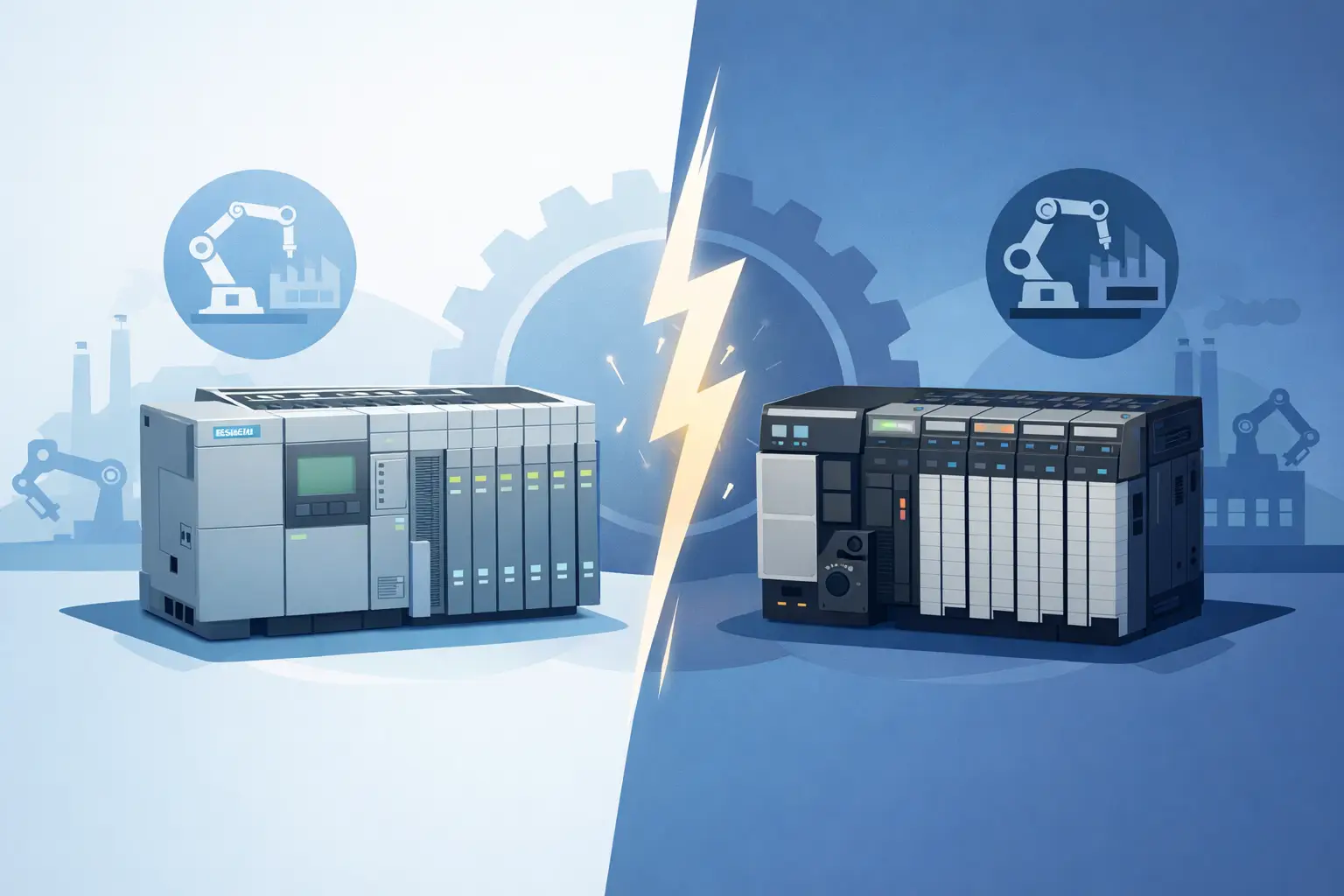
If you are comparing siemens vs allen bradley plc for a plant upgrade, machine retrofit, or new OEM build, the real question is usually not which brand is better in general. It is which platform fits your installed base, programming standards, support model, lead times, and long-term spare parts strategy. Both are established choices in industrial automation, but they solve purchasing and engineering problems in different ways.
Siemens vs Allen Bradley PLC: where the decision starts
In most US facilities, Allen-Bradley has the advantage of familiarity. Maintenance teams often know the software, local integrators are used to the ecosystem, and replacement part identification is straightforward if the line already runs Rockwell architecture. Siemens, on the other hand, is common in OEM equipment, multinational plants, and applications where global standardization matters. For many buyers, the selection is less about features on a spec sheet and more about reducing commissioning risk and keeping future replacements manageable.
That matters because PLC decisions do not stay inside the controls cabinet. They affect panel design, HMI integration, network layout, technician training, spare inventory, and service response years after startup. A lower upfront hardware price can become expensive if your team struggles with software access, diagnostics, or sourcing the right modules during an outage.
Hardware families and typical use cases
Allen-Bradley buyers in the US usually compare CompactLogix and ControlLogix for machine and line control. CompactLogix is common in standalone machines and mid-range systems, while ControlLogix is often used for larger architectures, process skids, and applications that need broader I/O or more coordinated motion. The product line is familiar to many North American integrators, which can reduce startup friction.
Siemens typically enters the conversation through S7-1200, S7-1500, and legacy S7-300 or S7-400 installations. S7-1200 fits smaller control tasks well, while S7-1500 is often chosen for higher-performance machine control and plant-level standardization. Siemens also has strong traction where distributed I/O, Profinet-heavy networks, or European OEM compatibility are part of the requirement.
From a hardware standpoint, both platforms cover discrete control, analog processing, communications, and safety. The differences show up more in architecture preferences, module availability, and how each brand handles expansion across a facility.
Allen-Bradley strengths in installed-base environments
Allen-Bradley tends to make the most sense when the rest of the plant already runs on Rockwell products. If your electricians and technicians know the hardware, if your HMIs and drives are already aligned with the ecosystem, and if your spare shelves already hold compatible modules, staying with that standard usually reduces operational friction. That is especially true when downtime costs more than any theoretical savings from switching brands.
Siemens strengths in standardization and global support
Siemens often stands out when a company needs consistency across sites in different regions or wants tighter alignment with equipment sourced from Europe or global OEMs. In those environments, standardizing on Siemens can simplify machine imports, engineering documentation, and multinational support practices.
Software and programming workflow
The software experience is often where opinions become strong. Allen-Bradley users typically work in Studio 5000, which many US engineers and technicians already know well. For teams trained on ladder logic and traditional Rockwell environments, it can be the faster path for troubleshooting on the plant floor. When personnel turnover is a factor, that familiarity can be worth real money.
Siemens users work within TIA Portal, which combines PLC, HMI, and related configuration tools in a more unified engineering environment. Some engineers prefer this integrated approach, especially on projects where device configuration and system-level consistency matter. Others find the learning curve steeper if their background is mainly Allen-Bradley.
Neither platform wins outright here. The right answer depends on who will support the machine at 2 a.m., not just who programmed it during commissioning. If your maintenance staff is strongest in one environment, that usually outweighs marginal software preferences.
Networking, integration, and plant architecture
Allen-Bradley is heavily associated with EtherNet/IP in North American plants, and that can simplify integration where drives, I/O, HMIs, and higher-level systems are already designed around Rockwell conventions. Siemens is closely tied to Profinet and has a strong position in architectures where that network standard is already established.
This matters during expansion projects. A greenfield system gives you more freedom, but a brownfield plant usually does not. If your facility backbone, device inventory, and SCADA expectations already favor one protocol family, choosing the other brand may add gateways, engineering time, and future troubleshooting complexity.
Integration with third-party devices is possible on both sides, but not always equally convenient. The closer your chosen PLC stays to the rest of your installed architecture, the less custom work your team will own later.
Cost is more than the controller price
A straight hardware quote rarely tells the full story in a siemens vs allen bradley plc comparison. Buyers need to account for software licensing, engineering labor, training, panel redesign, communication modules, and the cost of holding spares. A controller that looks less expensive on paper may increase total ownership cost if it requires retraining or forces nonstandard inventory.
Allen-Bradley is often perceived as the premium-priced option in the US market, especially when paired with the broader Rockwell stack. Siemens can be competitive depending on the architecture and required modules. But price varies by family, I/O count, communication needs, and the exact part numbers involved. It is risky to make a brand decision based on a generic assumption that one is always cheaper.
For procurement teams, another cost factor is replacement speed. If a platform is harder to source in your region or you carry fewer spare units internally, the financial impact of a delayed repair can erase any purchase savings.
Availability, lifecycle, and replacement planning
This is where practical buying concerns often take over from engineering preference. New projects can absorb some complexity. Emergency replacements cannot. If your site runs legacy S7 or older Allen-Bradley platforms, lifecycle status matters as much as performance. You need to know what is current, what is mature, and what may require migration planning rather than like-for-like replacement.
Availability also changes by part family. CPUs, power supplies, digital I/O, communication cards, and specialty modules do not all move through the market the same way. A platform with strong local familiarity may still present sourcing problems on specific SKUs. For maintenance managers and MRO buyers, exact part-number access is often the deciding factor.
This is one reason many industrial buyers prefer working with suppliers that carry multiple automation brands rather than a single-line source. When plants support mixed environments, procurement needs flexibility across Siemens, Allen-Bradley, and other installed equipment without splitting every order across multiple vendors.
Which platform fits your operation?
If your plant is already standardized on Rockwell, your technicians use Studio 5000 daily, and your spare inventory is built around Allen-Bradley modules, switching to Siemens usually creates more disruption than value. In that case, staying with Allen-Bradley supports continuity, faster troubleshooting, and simpler replacement planning.
If your operation supports multinational equipment, your engineering team is comfortable in TIA Portal, or your machinery base already leans Siemens, then Siemens is often the cleaner long-term choice. It can also be the practical option when OEM alignment and global service consistency matter more than local brand familiarity.
For OEMs and system integrators building new equipment for the US market, the answer depends on the customer base. End users in North America may strongly prefer Allen-Bradley for support reasons. Export-oriented machines or globally standardized platforms may be better served by Siemens. The best choice is often the one that reduces resistance at handoff and simplifies future service contracts.
The procurement view that gets overlooked
Controls engineers tend to focus on programming, performance, and architecture. Buyers and maintenance leaders usually have a different filter: how fast can we identify the right replacement, confirm compatibility, place the order, and keep production moving? That is a valid technical concern, not just a purchasing detail.
When comparing platforms, ask practical questions early. Can your team identify exact CPU and I/O part numbers without ambiguity? Are compatible accessories and expansion modules easy to source? Will the chosen platform create a second spare-parts ecosystem in the plant? Those answers often settle the debate faster than feature comparisons.
For mixed-brand facilities, a supplier such as American Automation 24 can help simplify cross-brand sourcing by giving buyers access to recognizable PLC hardware and related automation parts in one place. That is useful when standardization is incomplete and uptime depends on finding the exact component quickly.
The best PLC platform is the one your operation can support without hesitation. Choose the system your engineers can design well, your technicians can troubleshoot confidently, and your procurement team can replace without delay.