
Photoelectric Sensor vs Proximity Sensor
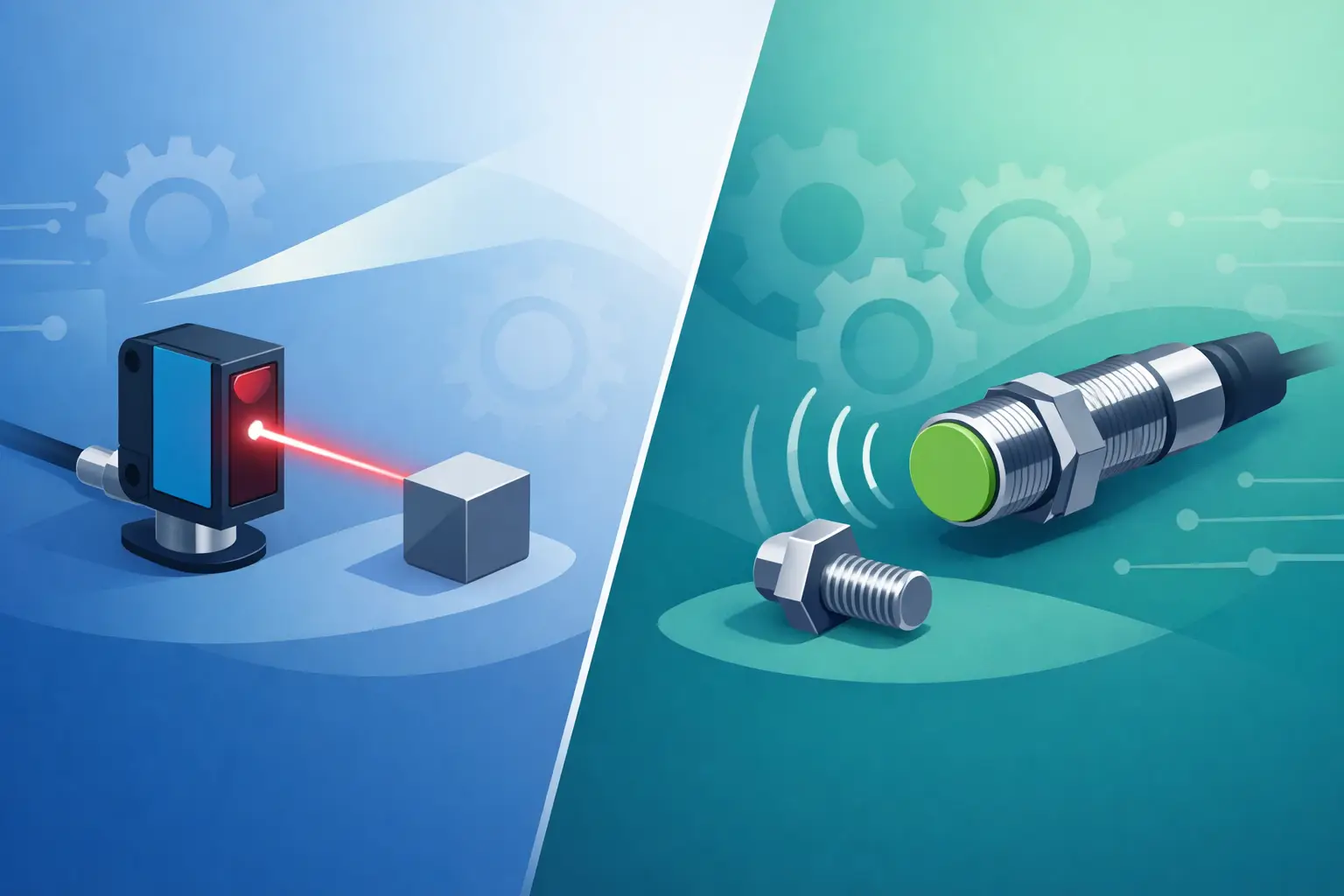
A sensor choice that looks minor on a BOM can create recurring faults on the floor. When teams compare a photoelectric sensor vs proximity sensor, the real question is not which one is better overall. It is which one will detect the target reliably in that machine, that environment, and that mounting position.
Both sensor types are common across packaging, conveying, material handling, machine tools, and general factory automation. Both can switch outputs fast enough for many industrial tasks. But they solve detection in different ways, and those differences affect repeatability, maintenance, false trips, and replacement decisions.
Photoelectric sensor vs proximity sensor: the core difference
A photoelectric sensor detects an object by using light. Depending on the design, it may send light to a reflector, receive light from a separate emitter, or detect light reflected directly from the target. The switching decision depends on whether that light beam is interrupted or returned at a sufficient level.
A proximity sensor detects an object at short range without relying on a visible optical path. In industrial use, this most often means an inductive proximity sensor for metal targets or a capacitive proximity sensor for non-metal materials. When buyers say "proximity sensor," they are often referring to inductive models unless the application clearly requires capacitive sensing.
That distinction matters because a photoelectric unit can often detect a wider variety of materials at longer distances. A proximity sensor usually offers more constrained sensing distance, but often with very stable short-range detection and less sensitivity to target color or optical finish.
Where photoelectric sensors make more sense
Photoelectric sensors are usually the first choice when the target is farther away, when the machine layout does not allow the sensor face to sit close to the object, or when the product mix includes materials that are not suitable for inductive sensing. Cartons, labels, plastic containers, pallets, clear bottles, and mixed package formats are common examples.
In through-beam setups, with separate emitter and receiver, photoelectric sensors can provide long sensing distances and strong detection reliability for part presence and counting. Retroreflective models reduce wiring and mounting complexity because the beam returns from a reflector. Diffuse models are the simplest mechanically, since they detect light reflected from the object itself, but they are also the most sensitive to surface color, angle, and finish.
That flexibility is why photoelectric sensing appears so often in conveyors, end-of-line equipment, access points, and packaging machines. If the job is simply to know whether something has entered a zone, crossed a beam, or arrived at a station, photoelectric is often the practical option.
The trade-off is that light-based detection can be affected by dust, washdown residue, product gloss, ambient light, and contamination on the lens. In a clean packaging area, that may be manageable. In a dirty metalworking or bulk material environment, the maintenance burden can become the deciding factor.
Where proximity sensors make more sense
Proximity sensors are strong candidates when the target comes close to the sensing face and the application values repeatable, short-range detection over long reach. Inductive sensors are especially common for metal part detection, cylinder position feedback, gear tooth counting, fixture confirmation, and end-of-travel sensing.
If a steel bracket passes within a few millimeters of the sensor every cycle, an inductive proximity sensor is often the straightforward answer. There is no lens to align and no beam path to keep clear. The sensing zone is localized, predictable, and well suited for machine frames, actuators, transfer tooling, and guarded spaces.
Capacitive proximity sensors expand the range of detectable materials to include plastics, powders, liquids, and bulk solids. That makes them useful for level detection and certain package or material presence applications. But capacitive models are typically more sensitive to environmental changes and may require careful adjustment.
For many maintenance teams, proximity sensors are preferred in harsh machine environments because they are compact, mechanically simple to mount, and less exposed to optical contamination issues. If the target is metal and close, proximity often wins on simplicity alone.
Sensing distance changes the selection fast
The biggest practical divider in a photoelectric sensor vs proximity sensor decision is sensing distance. Photoelectric sensors generally operate over much longer ranges than proximity sensors. That opens options for non-contact detection across conveyor widths, machine guarding gaps, or larger part approach zones.
Proximity sensors work at much shorter distances. Inductive models may be ideal at very close range, but they are not a substitute for an optical sensor across a long gap. Trying to force a proximity sensor into an application that needs reach usually leads to awkward brackets, inconsistent triggering, or physical exposure that shortens service life.
On the other hand, using a photoelectric sensor where the target is already within a few millimeters may add unnecessary complexity. If all that is required is to confirm a metal stop, actuator flag, or fixture seat point at close range, a proximity sensor is often the cleaner design.
Target material and surface matter
Material type is the next major factor. Inductive proximity sensors are designed for metal targets. They do that job well, but they will not detect cardboard, most plastics, or glass in the same way. If the application includes mixed product materials, inductive sensing may simply be the wrong category.
Photoelectric sensors can detect almost any material if the optical setup is suitable. But they do not ignore target characteristics. A black matte carton and a shiny foil package can behave very differently with a diffuse sensor. Clear object detection introduces another level of complexity and may require sensors built specifically for transparent materials.
Capacitive proximity sensors can sense non-metal targets, but performance depends on dielectric properties, moisture, buildup, and adjustment. They can solve problems that inductive units cannot, yet they are not a universal replacement for photoelectric sensing.
For buyers replacing an existing failed sensor, this is where exact part review matters. Two sensors may look similar physically but use different sensing principles that are not interchangeable in the machine.
Environment, maintenance, and false trips
A sensor that performs well in a catalog may still fail in the actual process area. Dust, oil mist, caustic washdown, steam, vibration, metal fines, and product residue all influence real-world performance.
Photoelectric sensors need a clear optical path. Even minor contamination can reduce signal strength or shift switching stability. Some premium models from manufacturers such as Sick, Keyence, Omron, IFM, and Allen-Bradley include background suppression, teach functions, contamination indicators, and stronger optical design to reduce nuisance issues, but they still depend on light transmission.
Proximity sensors are less vulnerable to lens fouling because there is no optical window to keep clear in the same way. Inductive sensors are often the safer option near coolant splash, chips, and grimy machine zones. That does not make them immune to damage, though. Mechanical impact, cable failures, and incorrect flush or non-flush mounting remain common causes of trouble.
If a line has a history of intermittent faults, the correct sensor decision is often the one that reduces maintenance touchpoints, not the one with the broadest spec sheet.
Output, mounting, and replacement considerations
Selection does not stop with sensing principle. Buyers still need to check output type, supply voltage, connector style, housing size, mounting thread, sensing range, switching frequency, and environmental rating. PNP vs NPN, normally open vs normally closed, DC 3-wire vs 2-wire, and M8 vs M12 connection details all matter at replacement time.
In proximity sensors, flush and non-flush mounting affects usable sensing distance. In photoelectric sensors, the optical mode matters just as much as the housing. A diffuse model is not a direct substitute for a retroreflective or through-beam setup just because the footprint matches.
This is where cross-brand procurement can get complicated. A Siemens control platform may be paired with Omron or Sick sensing hardware, while a machine retrofit may introduce IFM or Schneider components based on availability and fit. Technical teams usually need exact electrical and mechanical compatibility first, then lead time and brand preference second.
Which one should you buy?
If the target is metal, close to the sensor, and the environment is dirty or mechanically tight, a proximity sensor is often the safer purchase. If the target varies in material, needs to be detected from farther away, or must be sensed across a defined gap, a photoelectric sensor is usually the better fit.
There are gray areas. A capacitive proximity sensor may handle a level detection task that a photoelectric sensor struggles with due to dust. A specialized photoelectric sensor may outperform a capacitive unit on certain package detection jobs where adjustment drift is a concern. That is why replacement by appearance alone is risky.
For industrial buyers, the fastest path is usually to work from the existing part number, confirm the sensing principle, and then verify the electrical and mechanical details against the application. If the original design had nuisance failures, that is the moment to revisit whether the machine should be using photoelectric sensing or proximity sensing at all.
A good sensor purchase is not the one that checks the most boxes on paper. It is the one that keeps the machine running without asking for attention every shift.