
Industrial Enclosure Cooling Guide for Panels
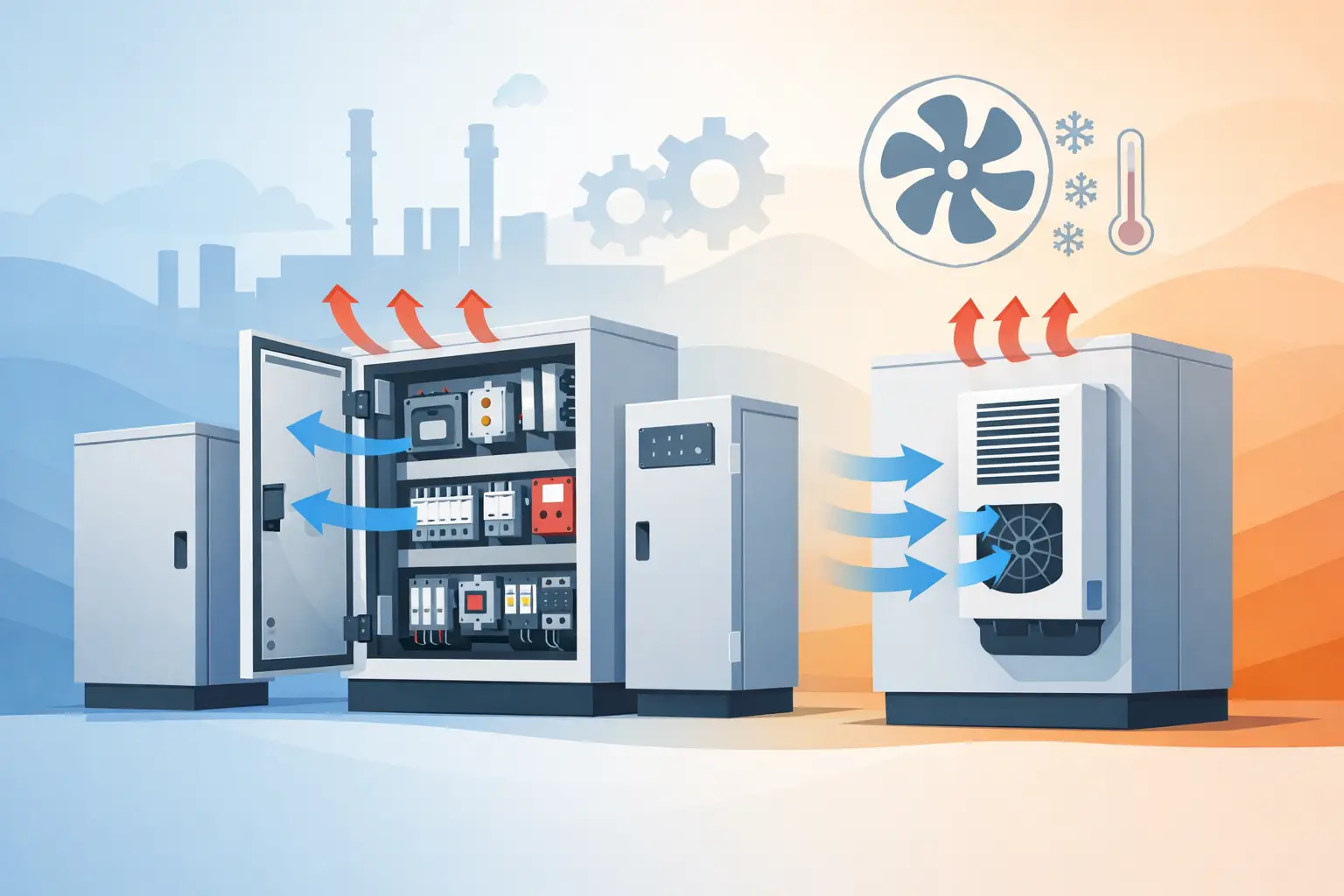
A control panel that runs hot rarely fails all at once. It begins with intermittent drive faults, nuisance PLC resets, shortened power supply life, and components that work during a cool morning but trip during the afternoon shift. This industrial enclosure cooling guide is built for the practical decision: identify the actual heat load, account for the plant environment, and select a cooling method that protects uptime without creating new maintenance problems.
Industrial Enclosure Cooling Guide: Start With Heat Load
Cooling equipment should be selected from the enclosure heat load, not from panel dimensions alone. A large cabinet with a few low-watt components may need no active cooling. A compact enclosure containing VFDs, servo drives, power supplies, braking resistors, and network hardware can require substantial heat removal.
Start with the published heat dissipation of every device installed in the panel. Manufacturers commonly list loss values in watts, either as a fixed number or as a percentage of operating power. Add the expected losses from drives, transformers, power supplies, PLC racks, safety controllers, Ethernet switches, contactors, and other heat-producing devices. Use the highest normal operating condition rather than an unloaded or intermittent condition.
Do not confuse input power with heat loss. A 10 hp VFD may handle several kilowatts of motor power while dissipating only a fraction of that value as heat. Its data sheet, installation manual, and derating information are the correct sources. If the panel includes future capacity, decide whether the cooling system should accommodate that planned expansion now. Retrofitting a larger cooling unit after equipment is installed can be costly and may require panel rework.
The next variable is the maximum ambient temperature around the enclosure. A 95°F plant floor, a sun-exposed outdoor cabinet, and an electrical room with conditioned air are different applications even when the internal components are identical. Define the maximum allowable enclosure temperature from the most temperature-sensitive installed component. Then calculate the temperature difference between the surrounding air and the desired internal temperature. That difference determines whether passive heat loss or a simple filtered fan system can do the job.
Check the Enclosure Before Adding Cooling
Panel layout affects cooling capacity as much as the selected cooling device. Heat rises, so high-loss equipment placed near the top of the enclosure can create hot zones around terminal blocks, communications equipment, or PLC modules. Follow clearance requirements around VFDs and power supplies, particularly above and below units that depend on vertical airflow.
Separate heat-generating devices from low-temperature electronics where possible. Drives and transformers belong away from PLC CPUs, analog modules, and managed switches. If a cabinet has multiple compartments, calculate heat and airflow needs for each section. Air movement in one compartment does not automatically cool another.
The enclosure rating also sets limits. Cutting fan openings into a washdown-rated or outdoor enclosure may compromise the required NEMA or IP protection. An enclosure with a high protection rating may need a closed-loop solution, such as an air conditioner, air-to-air heat exchanger, or air-to-water heat exchanger. Cooling performance is only useful if the cabinet remains protected from the contaminants and moisture found in the application.
Choose the Cooling Method That Matches the Environment
There is no single best enclosure cooling method. The right choice depends on heat load, ambient temperature, airborne contaminants, washdown exposure, available utilities, maintenance capacity, and the required enclosure rating.
Natural convection and passive heat dissipation
For low heat loads, an adequately sized metal enclosure may reject heat through its surfaces without fans or refrigeration. This is the lowest-maintenance approach because there are no moving parts, filters, or condensate systems. It works only when the enclosure surface area is sufficient and the ambient temperature stays below the required internal temperature.
Passive cooling becomes less reliable when the cabinet is tightly packed, mounted in direct sunlight, installed near furnaces, or located where ambient temperatures fluctuate. It should be verified with thermal calculations, not assumed from enclosure size.
Filtered fans and exhaust systems
Filtered fan systems exchange hot internal air with cooler plant air. They are cost-effective where the surrounding air is clean enough and consistently cooler than the desired enclosure temperature. Intake fans are usually placed low on the enclosure, with exhaust filters or outlets high on the opposite side to support the natural upward movement of heat.
This approach has a clear trade-off: every cubic foot of plant air entering the enclosure can carry dust, fibers, oil mist, and moisture. Filters require inspection and replacement. A clogged filter reduces airflow and can turn a properly sized design into an overheating event. In facilities with paper dust, machining coolant mist, flour, cement, or corrosive vapors, filtered ventilation may create more risk than it removes.
Air-to-air heat exchangers
Air-to-air heat exchangers keep internal and external air streams separate. Internal enclosure air circulates through one side of the heat exchanger while external ambient air passes through the other. Heat transfers across the exchange surface without bringing plant contaminants into the cabinet.
They are a practical option when the ambient air is cooler than the target internal temperature but the environment is too dirty for open-loop fan cooling. Capacity falls as the difference between internal and external temperatures narrows, so they are not a substitute for air conditioning in high-ambient areas.
Enclosure air conditioners
An enclosure air conditioner is typically required when the ambient temperature can equal or exceed the desired cabinet temperature, or when the enclosure must remain closed to outside air. It removes heat through a refrigeration cycle and can maintain a controlled internal temperature independent of the plant air, within its rated operating limits.
Air conditioners require more attention during selection. Verify cooling capacity at the actual ambient condition, not only the nominal rating. Check supply voltage, frequency, mounting orientation, enclosure cutout dimensions, clearance for condenser airflow, and service access. A unit mounted where its condenser side recirculates hot discharge air will deliver less cooling than its catalog rating suggests.
Condensate management matters as well. Depending on the design and operating conditions, moisture may need to be drained or evaporated. In humid spaces, verify that the system will not introduce condensation risk inside the enclosure during shutdown periods.
Air-to-water heat exchangers
Where clean, controlled water is available, air-to-water heat exchangers can remove high heat loads while keeping the enclosure sealed from plant air. They are often considered in process plants, high-temperature areas, or installations where refrigerant-based cooling is not preferred. The trade-off is dependence on water quality, flow, supply temperature, hose routing, and leak prevention. This is generally an engineered solution rather than a simple fan retrofit.
Size for the Worst Operating Condition
Catalog capacity figures are useful only when the test conditions match the installation. For a fan or heat exchanger, capacity is closely tied to the temperature difference between the enclosure interior and the surrounding air. As ambient temperature rises, available heat rejection drops. For an air conditioner, capacity can also decline at elevated ambient temperatures.
Use the worst credible operating condition: all relevant drives running, enclosure doors closed, filters approaching normal service condition, and the highest expected ambient temperature. Add a reasonable margin for seasonal variation, process changes, and normal component aging. Oversizing should still be avoided if it causes rapid cycling, excessive energy use, or unnecessary panel cutouts. The goal is stable operating temperature, not the coldest possible enclosure.
A practical field review should confirm at least these four conditions:
- Total device heat loss at normal maximum production load.
- Maximum ambient temperature at the enclosure location, including nearby equipment and solar gain.
- Required internal temperature based on the lowest-rated installed component.
- Exposure to dust, oil, washdown, corrosive air, humidity, and other contaminants.
Also review where the enclosure sits. A cabinet mounted against a wall, above a heat source, or in a poorly ventilated mezzanine may see temperatures far above the general building thermostat reading. Measure near the panel, preferably during normal production, rather than relying on a facility average.
Installation Details That Protect Cooling Capacity
Correctly sized cooling equipment can still underperform because of installation errors. Maintain manufacturer-specified clearances around fans, heat exchangers, and air conditioners. Keep intake and discharge paths clear. Avoid locating an intake directly beside a hot exhaust source or placing multiple units so their airflow interferes with each other.
For filtered fan systems, establish a filter inspection interval based on the actual environment. A clean electronics room may allow a longer interval; a dusty packaging or machining area may require frequent checks. Do not wait for a high-temperature alarm to discover that filters are blocked.
For air conditioners, clean condenser surfaces, inspect door seals and enclosure gaskets, and verify that cutouts are sealed correctly. Leaky doors and cable-entry points allow warm, humid air into the cabinet, increasing the cooling load and raising condensation concerns. Confirm that panel cooling equipment is protected by the correct branch circuit, disconnecting means, and grounding practices.
Temperature monitoring provides useful confirmation after commissioning. Place sensors near the hottest expected zone, not only at the bottom of the enclosure. Trend temperatures through a production cycle and set alarms below the component damage threshold. A temperature alarm should trigger maintenance action before a drive or PLC fault stops the machine.
When replacing a failed fan, heat exchanger, or air conditioner, match more than the physical dimensions. Confirm voltage, frequency, cooling capacity, enclosure rating, mounting cutout, airflow direction, and any thermostat or alarm contacts required by the control design. Exact model identification and documented operating conditions make replacement sourcing faster and reduce compatibility errors.
A panel cooling decision should support production continuity for years, not simply lower a temperature reading on the day it is installed. When heat load, ambient conditions, enclosure protection, and maintenance access are reviewed together, the selected solution is easier to source, install, and keep operating when the plant needs it most.